
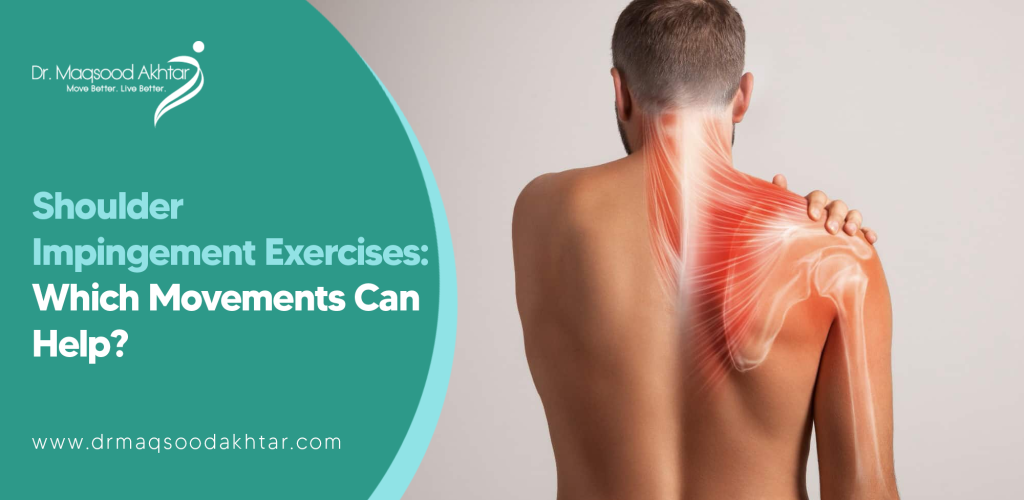
Getting to the top shelf shouldn’t be a form of torture. But for some individuals, even the slightest attempt to put on a coat or brush their hair causes pain in their shoulder. In most adults, that pain comes down to shoulder impingement. This problem can be experienced by office workers, swimmers, painters, athletes, and those who sleep on one side every night. Shoulder impingement exercises are one of the most effective treatments for shoulder pain.
Whether the cause is posture or repeated overhead motion, patients still need an accurate diagnosis and a shoulder pain treatment plan from a specialist like Dr. Maqsood Akhtar. He has more than 20 years of experience treating various shoulder problems in Lahore.
The following article discusses shoulder impingement and the mechanics of shoulder impingement exercises.

The shoulder joint is a ball-and-socket joint that’s held together by a muscle and tendon complex called the rotator cuff. The tendons pass through a narrow tunnel covered with bone on the top of the shoulder joint, which becomes even narrower as the arm is raised.
Impingement of the shoulder occurs when the tendons or the cushion-like, fluid-filled sac (bursa) adjacent to them gets pinched in this space. It gets inflamed and painful. Picture a rope being rubbed repeatedly against a rough surface – it will wear out and hurt. Some common symptoms are:
Impingement is not usually a result of a single cause, but rather develops over time through a series of actions, including:
The shoulder shouldn’t be moved excessively if it causes pain. But lack of motion for a long time leads to the weakening of muscles and the stiffness of joints in the shoulders. Good exercise for shoulder impingement should include the following aspects: it should stretch tight muscles, strengthen muscles that become weak, and increase the movement of the shoulder blades, providing more space for the tendons.
Here are several safety tips that one must consider before starting shoulder impingement exercises:
| Exercise | How It Is Done | Suggested Amount | Main Benefit |
|---|---|---|---|
| Pendulum swing | Lean forward, let the arm dangle and sway gently | 30 to 60 seconds | Relaxes the joint and eases early stiffness |
| Shoulder blade squeeze | Pull the shoulder blades back and together | 10 reps, hold 5 seconds | Improves posture and blade support |
| Towel stretch | Hold a towel behind your back and gently pull up | 3 reps, hold 20 seconds | Increases reach and flexibility |
| Cross-body stretch | Pull the arm across the chest | 3 reps, hold 20 seconds | Loosens the back of the shoulder |
| Doorway chest stretch | Rest forearms on a door frame and lean forward | 3 reps, hold 20 seconds | Opens up tight chest muscles |
| Resistance band external rotation | Keep the elbow at the side and rotate the forearm outward | 10 to 12 reps | Strengthens the rotator cuff |
| Wall slides | Slide the forearms up a wall slowly | 8 to 10 reps | Builds controlled overhead movement |
This strengthening exercise involves a person holding a resistance band with both hands, elbows bent and tucked in at the sides of the body. After that, the forearm is turned away from the body and brought back inwards.
This helps strengthen the muscles of the rotator cuff, which are joint-stabilizing muscles. Strengthening exercises like these are very important in the case of shoulder impingement, as these exercises avoid irritation of the tendons.
Tired of persistent shoulder pain? Regain pain-free movement with expert shoulder pain treatment by Dr. Maqsood Akhtar.
Exercises should be combined with other simple approaches such as:
An orthopedic doctor in Lahore can assess shoulder pain and recommend suitable treatment, while at-home care may help manage mild to moderate symptoms.
Medical help is required if there is:
Shoulder impingement can often be managed with appropriate exercises, stretching, and muscle strengthening. Frozen shoulder treatment may also involve physiotherapy and guided exercises to improve shoulder mobility, depending on the underlying condition.
A lot of people return to reach the shelves and sleep without any discomfort after proper consultation and treatment of shoulder pain. All those who are unsure what to do are recommended to consult an orthopedic specialist, Dr. Maqsood Akhtar, for advanced shoulder pain treatment in Lahore. He provides expert diagnosis, minimally invasive solutions, and a tailored recovery plan backed by two decades of orthopedic expertise.